London's parks constitute a substantial and largely underused training infrastructure. Across the capital, grass expanses, paved paths, staircases, and fixed-bar installations provide the structural conditions for a complete no-equipment fitness programme — one that requires no membership, no commute to a facility, and no specialised gear beyond appropriate footwear.
01 — Spatial Assessment
Mapping the Environment Before the Session
Before establishing a repeatable outdoor routine, a systematic survey of the chosen park is worth conducting. The variables that affect session quality are consistent: surface firmness for press and plank work, gradient availability for hill sprint intervals, overhead bar installations for pull-up alternatives, and bench height for step and dip mechanics. A park that scores well across all four categories can support a full-body programme indefinitely.
In Greater London, the highest-density installations of fixed bars are concentrated in Victoria Park (east), Clapham Common (south), and Hampstead Heath (north). Each provides a different environmental context — and terrain variation itself constitutes a training variable worth accounting for. Uneven ground increases proprioceptive demand during squat and lunge patterns; inclines shift muscular emphasis within the same movement template.
For runners, the relationship between surface and impact load is measurable. Compressed grass delivers roughly 10-15% more shock absorption than compacted stone paths. For individuals managing lower-limb fatigue, routing the sprint intervals onto grass and the recovery walks onto tarmac is a structurally sound approach that most outdoor runners do not explicitly plan for.
Field Note
"A well-surveyed park replaces the gym floor, the weight rack, and the cardio zone simultaneously — provided the athlete knows how to read the space."
— Ordanel Quarterly, January 2026
02 — Push-Up Architecture
Push-Up Progressions: From Foundation to Advanced Loading
The push-up is frequently reduced to its most basic form in outdoor settings — a horizontal pressing movement with no load variation. This is a structural underutilisation. The push-up exists on a progression continuum that begins at wall-incline variations and extends through archer push-ups, pseudo-planche progressions, and ring push-up equivalents achievable with park bench geometry.
The key mechanical variable across the progression is the angle of torso inclination relative to the ground. Elevating the hands (incline push-up) reduces the percentage of bodyweight loaded through the arms; elevating the feet (decline push-up) increases it and shifts the primary stimulus toward the upper clavicular region of the pectoralis major. At a foot elevation of approximately 45cm — the height of a standard park bench — the load distribution shifts by an estimated 15% compared to flat-ground performance.
For individuals with a baseline of 20+ consecutive flat push-ups, the recommended progression sequence is: feet-elevated → archer → slow-eccentric (4-second descent) → pause-at-bottom → explosive concentric. Each modification adds a distinct mechanical stimulus without requiring external load. The archer variation in particular places an asymmetric demand on the pressing shoulder that approximates the joint-angle demands of a single-arm progression far more safely than attempting a full one-arm push-up without preparation.
Tempo manipulation is the most underused variable in outdoor bodyweight work. A standard push-up completed at a 3-1-1-1 tempo (3 seconds down, 1 second pause, 1 second up, 1 second pause) produces substantially greater time-under-tension than a rhythmically bounced repetition counted at pace. This has direct implications for load tracking: a session of 40 tempo-controlled push-ups represents considerably greater mechanical stress than 80 fast repetitions.
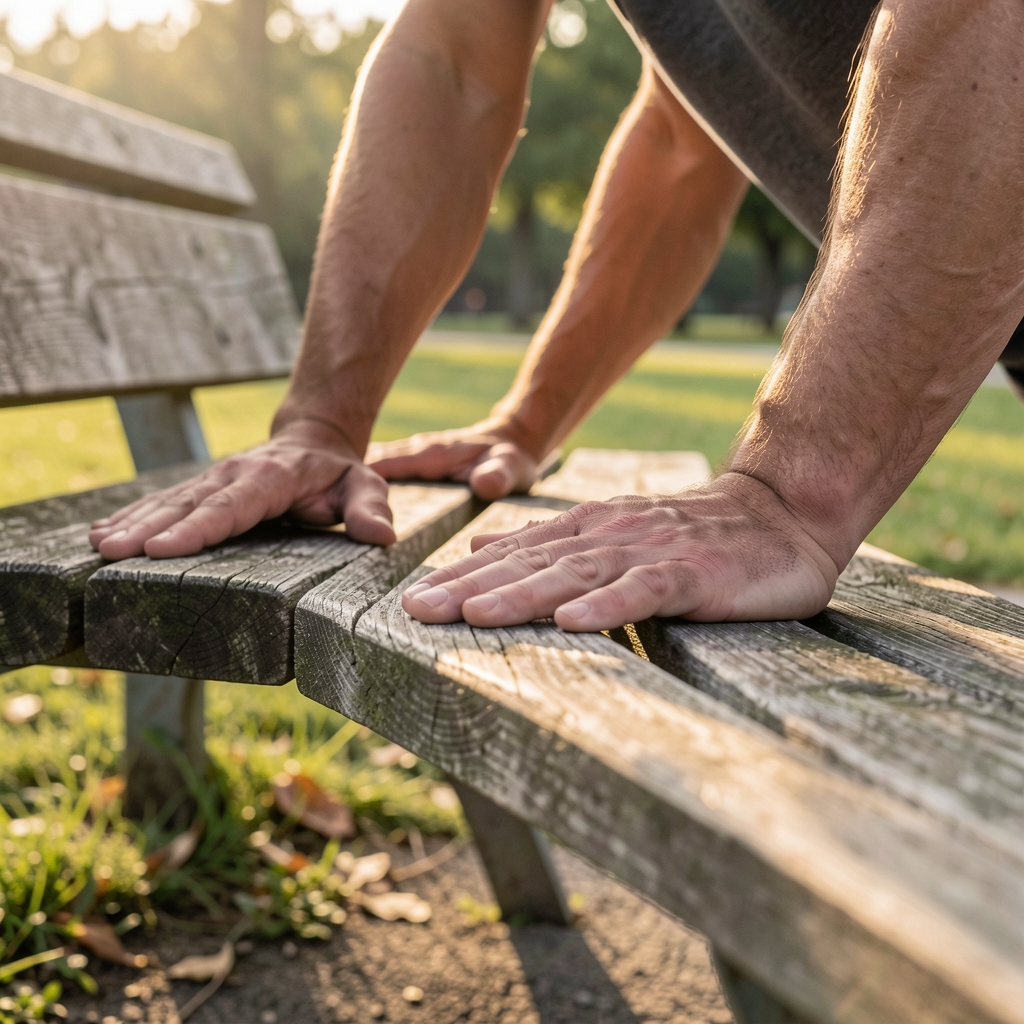
Park bench geometry — incline and decline progressions. London, January 2026.
03 — Lower Body Mechanics
Squat Variations and the Role of Surface Gradient
The squat pattern in outdoor training contexts benefits from terrain variation in a way that flat-floor gym squats cannot replicate. A squat performed on a slight forward incline encourages greater anterior tibial translation and demands increased ankle dorsiflexion — a structural challenge for many men whose desk-based routines have shortened the posterior chain over time. A squat performed on a slight back incline reduces this demand and can serve as a useful regression for those working to restore range of motion.
The progression sequence for outdoor squat work follows a logical mechanical hierarchy: bodyweight squat → pause squat (3 seconds at depth) → single-leg box squat (using bench or low wall) → pistol squat progression (using a tree or railing for counterbalance assistance). This sequence addresses both strength and mobility simultaneously, as each step up the hierarchy requires greater range and greater single-leg stability.
Hill sprints introduce a third dimension to lower-body outdoor training. A gradient of 6-10% (achievable in parks such as Greenwich, Primrose Hill, and Parliament Hill) is sufficient to significantly increase glute and hamstring activation relative to flat-surface running, while reducing peak impact force on the knees due to the forward lean that uphill mechanics naturally produce. A structured hill sprint session — 6 to 10 repetitions of 20-30 second efforts with full recovery between — is a time-efficient and mechanically varied lower-body stimulus.
Stair workouts in parks with stone or concrete steps (the steps of Waterlow Park and the terraced sections of Crystal Palace Park are frequently cited by outdoor fitness practitioners) add a plyometric dimension. Two-step bounding increases stride length and hip extension demand beyond what a single-step rhythm produces. Three-step bounding tests hip flexor range at the recovery phase of the stride in a way that standard running does not.
Key Observations
-
—
Surface gradient is a programmable variable, not an inconvenience: slope angle alters muscular demand measurably across squat and sprint patterns.
-
—
Tempo manipulation in push-up progressions produces greater time-under-tension than increasing repetition count at an uncontrolled pace.
-
—
A systematic pre-session survey of park infrastructure enables more precise session design than improvised use of available space.
-
—
The push-up progression continuum extends well beyond the standard flat variation; bench geometry and tempo are the primary tools for outdoor load management.
04 — Mobility Integration
Mobility Drills as Structural Session Components
Mobility drills occupy an ambiguous position in most outdoor fitness routines: performed perfunctorily at the session start as a warm-up formality, or omitted entirely in favour of additional working sets. Neither approach reflects the structural function that mobility work performs. Dynamic flexibility routines — specifically those addressing hip flexor range, thoracic rotation, and ankle dorsiflexion — directly determine the quality of the movement patterns that follow them.
A pre-session mobility sequence of 8-10 minutes, structured around the movement demands of the planned session, is a different proposition from a generic 5-minute stretch. For a session prioritising squat depth and hip-hinge mechanics, the preparatory sequence should include: 90/90 hip rotations, world's greatest stretch variations, ankle circles with load, and thoracic openers against a wall or vertical surface. Each of these addresses a specific range requirement that the main session will tax.
Post-session flexibility routines serve a distinct purpose. Static holds of 45-60 seconds per position — applied to hip flexors, hamstrings, and pectorals following a push-dominant session — do not reduce strength within the session (the concern that led many practitioners to abandon post-workout stretching) but do appear to support sustained range of motion over time. The evidence basis for static stretching as a recovery modality is narrower than its widespread use implies; it is most defensible as a practice for maintaining existing range in frequently trained tissue.
05 — Session Architecture
Constructing a Repeatable Weekly Structure
The practical challenge of outdoor training for working men in London is not motivation or access — it is session architecture. Without a pre-planned structure, sessions default to familiar patterns (running + a handful of push-ups) that do not produce the progressive overload necessary for continued adaptation. A structured outdoor home training programme requires the same periodisation logic as any other fitness plan: defined stimulus categories, rotation of emphasis across the week, and explicit progression criteria for each movement.
A three-session weekly structure distributes the stimulus categories as follows: Session A (upper body push + pull alternatives + mobility), Session B (lower body pattern + hill sprints + active recovery), Session C (full-body calisthenics circuit + flexibility routine + daily step count audit). This distribution ensures that no single pattern is repeated consecutively and that mobility receives dedicated session time rather than being relegated to a warm-up addition.
Active commuting serves as a fourth training variable that most outdoor fitness practitioners do not account for in their weekly load calculation. A 3km walk to work, repeated five days per week, contributes 15km of accumulated low-intensity movement that meaningfully affects recovery capacity and daily step count targets. viewing the commute as a training asset — rather than a transport necessity — shifts the arithmetic of weekly energy expenditure considerably without adding session time.