The central misconception about calisthenics as a fitness methodology is that it lacks the capacity to produce progressive overload equivalent to weighted training. This view is a consequence of viewing the bodyweight squat and the weighted back squat as comparable stimuli at equivalent stages of an athlete's development — they are not, and the progression architecture of well-structured calisthenics practice demonstrates why.
01 — Foundational Mechanics
The Lever Principle and Load Management in Bodyweight Practice
In weighted training, progressive overload is achieved primarily by incrementing the external load — adding plates to a bar, selecting a heavier dumbbell. In calisthenics, overload is achieved by altering the mechanical leverage relationship between the body's centre of mass and the fulcrum of the movement. This is a less intuitive but equally precise method of load management once its principles are understood.
The foundational lever principle in calisthenics can be observed most clearly in plank progressions. A standard forearm plank distributes load across four contact points (two elbows, two feet). Raising one foot creates a three-point contact and asymmetrically increases the anti-rotational demand on the obliques and contralateral hip stabilisers. Raising one arm simultaneously creates a two-point contact (one elbow, one foot) and approximates the load distribution of a significantly harder variation without adding a gram of external weight.
The RKC plank is a further mechanical refinement of the standard position: the forearms are rotated slightly inward, the glutes are forcefully contracted, and the intent is to create full-body tension through muscular co-contraction rather than passive structural loading. EMG analysis cited in applied exercise research suggests the RKC position produces substantially higher core activation than the standard forearm position held for an equivalent duration — without any change in body position that would be visible to an observer.
These distinctions matter because they reframe the plank series from a static endurance test (hold as long as possible) into a manipulable loading tool (select the variation that produces the targeted stimulus within a controlled duration). A 20-second two-point plank with maximal co-contraction may represent a superior stimulus to a 3-minute standard plank held with declining tension, for any athlete whose primary goal is anterior core strength rather than muscular endurance.
Observation
"Progressive overload in calisthenics is a matter of mechanical precision, not muscular endurance accumulation. The distinction is one of intent, and it changes everything about how a session is designed."
— Ordanel Quarterly, February 2026
02 — Pulling Patterns
Pull-Up Alternatives and the Accessible Pulling Continuum
The pull-up is the paradigmatic upper-body pulling movement in no-equipment training, and its absence from a given outdoor environment is frequently cited as a reason to neglect the pulling pattern entirely. This is a structural gap that a well-designed home training programme should address from the outset, because pulling-pattern weakness relative to pushing-pattern strength is one of the most consistently observed asymmetries in men who train without access to a full facility.
Pull-up alternatives in genuinely equipment-free contexts include table rows (using any low horizontal surface stable enough to bear bodyweight), inverted rows using a barbell or fixed bar at waist height, and door-frame rows using a towel looped around a secure structural element. Each approximates the horizontal pulling pattern to varying degrees; none replicate the vertical pulling geometry of a standard pull-up, which is why overhead bar access (even a park installation bar) represents a meaningful difference in programming capacity.
For those with overhead bar access, the progression from dead hang to full pull-up passes through: scapular pull-ups (engaging the shoulder girdle retractors without elbow flexion), assisted negatives (jumping to the top position and controlling a 4-6 second descent), partial range pull-ups (initiating from a dead hang to the point of the chin clearing approximately 60% of the way to the bar), and finally full range pull-ups with neutral, supinated (chin-up grip), and pronated grip variations.
Archer pull-ups follow the same asymmetric loading logic observed in the archer push-up progression: one arm bears the primary pulling load while the other provides stabilising assistance at an extended position. This creates a unilateral stimulus that approaches single-arm pulling without the prohibitive joint demand that a cold single-arm attempt would impose. The archer pull-up is, in structural terms, an intermediate step on the progression from bilateral to unilateral pulling — a progression that most practitioners do not attempt but which represents a qualitatively different category of pulling strength.
03 — Plank Series
The Plank Series as a Progressive Loading System
The plank series constitutes one of the most programmatically rich tools in calisthenics precisely because it offers so many mechanical variation axes without requiring additional equipment. The axes available for manipulation are: contact points (four to two to one), temporal structure (duration vs. repetitions of isometric contractions), co-contraction intensity (passive structural hold vs. active whole-body bracing), and positional variation (standard, side, reverse, extended arm).
The standard forearm plank and the extended-arm plank are not merely variations in arm position — they represent fundamentally different mechanical demands. The extended-arm position creates a longer moment arm from the hands to the centre of mass, increasing the torque demand on the anterior core musculature. A practitioner who can hold a forearm plank for two minutes may find a 30-second extended-arm position with co-contraction intent to be a comparable or superior challenge.
The side plank series follows the same progressive logic applied to the lateral plane. A standard side forearm plank leads to a side plank with hip abduction (raising the top leg), then to a Copenhagen plank (top leg elevated on a bench with the body held off the ground), which produces some of the highest hip adductor activation levels recorded in no-equipment movement research. The Copenhagen plank is almost entirely absent from popular outdoor fitness guides despite being achievable with nothing more than a park bench and awareness of its existence.
Incorporating the plank series into a structured home training programme as a progressive system — rather than a daily maximum-duration test — requires viewing it like any other resistance pattern: define the target variation, establish the intensity parameters (duration, repetitions, tempo, co-contraction intent), apply those parameters consistently for 3-4 weeks, then progress to the next point on the mechanical hierarchy.
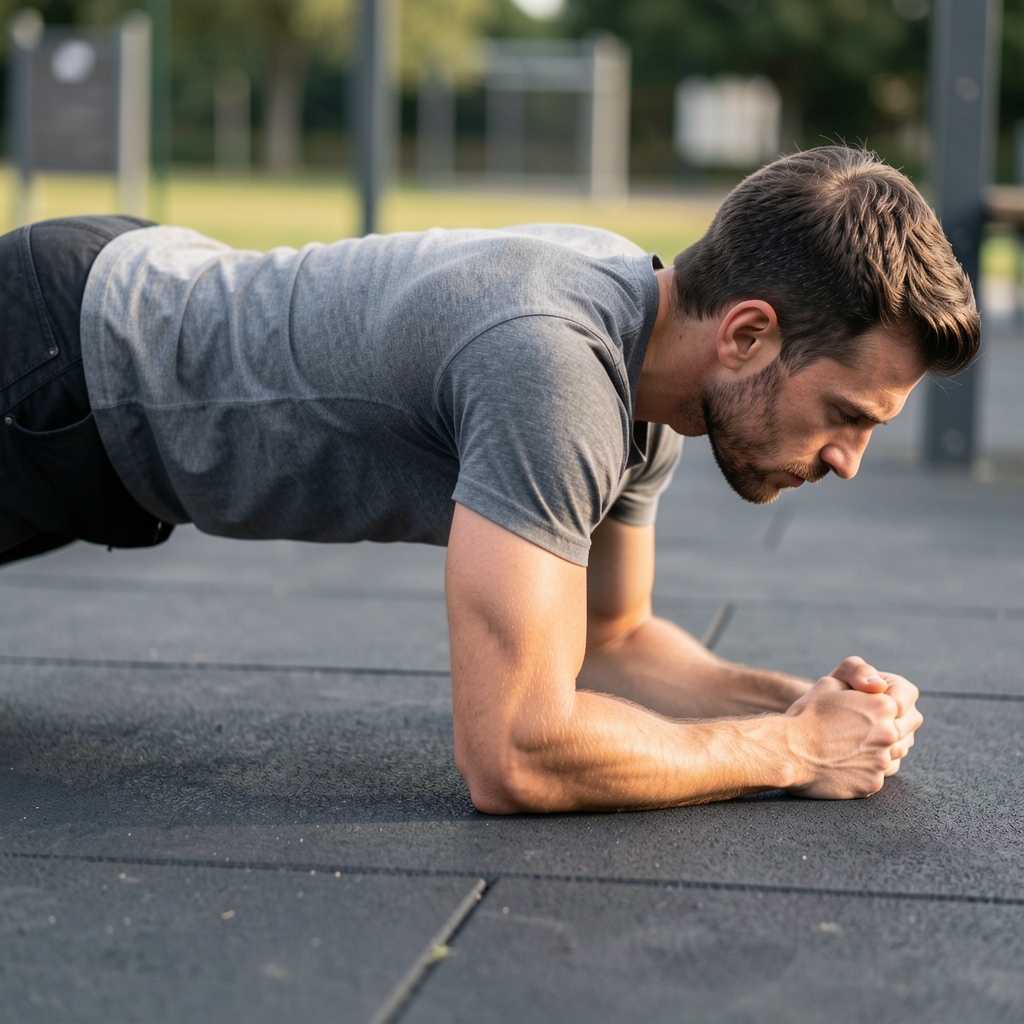
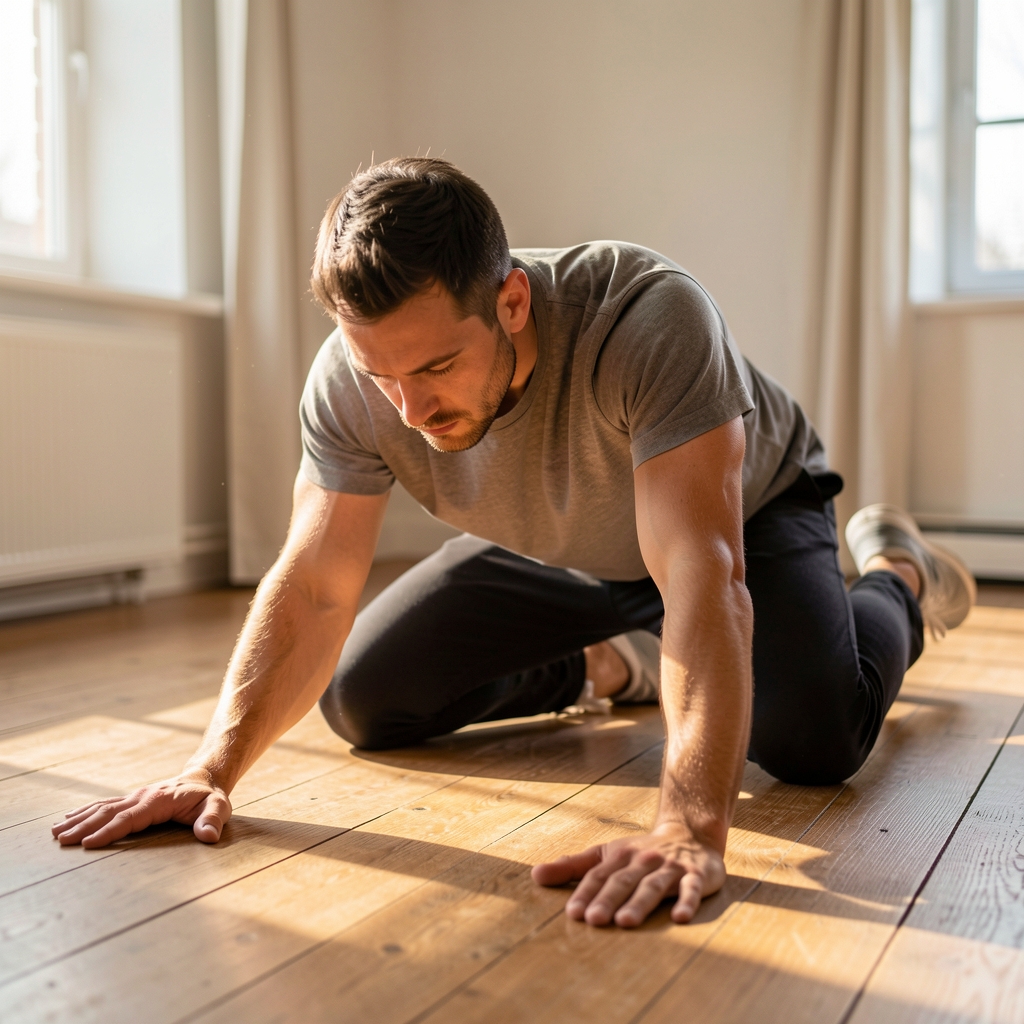
Forearm plank: structural alignment and co-contraction intent. London, February 2026.
04 — Resistance Band Integration
Resistance Band Training as a Calisthenics Complement
Resistance band training occupies a hybrid position between pure calisthenics and equipment-based training. A loop band (typically available in resistance ratings from 5kg to 50kg equivalents) introduces genuine external load while remaining compact, portable, and usable in any outdoor or home environment. Its inclusion does not invalidate the no-equipment framework; it extends it.
The primary value of resistance band training within a calisthenics-based programme is in addressing patterns that pure bodyweight work handles poorly. The horizontal rowing pattern is the most significant gap: banded rows performed with the band anchored to a fixed vertical structure (a fence post, a tree, a railing) can be performed at various torso inclinations and grip orientations, approximating cable row mechanics with adjustable resistance. This is a qualitatively different stimulus from the table row or doorframe row alternatives, and for men with significant pulling-pattern deficits, the additional loading capacity matters.
Banded pull-apart exercises — performed bilaterally with the band held at shoulder height and arms extended — address posterior shoulder health in a way that pressing-dominant outdoor routines consistently neglect. The external rotation and scapular retraction involved in a banded pull-apart pattern counteract the internal rotation loading pattern that push-ups, bench dips, and all horizontal pressing movements accumulate over time.
For lower body work, a loop band placed above the knees during squat variations adds abductor activation that standard bodyweight squats do not produce in meaningful quantities. For a man whose daily sitting posture maintains persistent hip flexion and internal rotation, the abductor activation cue provided by light band resistance during squat depth work is both a corrective and a strength stimulus.
05 — Intensity Markers
Structural Intensity Markers for Objective Session Tracking
One of the practical challenges of calisthenics-based training is objective progress tracking. In weighted training, the metric is straightforward: load lifted across sets and repetitions. In calisthenics, the equivalent metric requires encoding both the variation performed and the intensity parameters applied, which most practitioners do not record in a form that allows retrospective analysis.
A structured intensity marker system assigns numerical codes to variation level (1 = foundational, 2 = intermediate, 3 = advanced within the progression), repetition count, tempo notation, and co-contraction intent rating. A session record entry might read: Push 3 / 5 reps / 3-1-1-1 tempo / co-contraction 8. This encodes: advanced push-up variation (archer, decline, or equivalent), five repetitions, four-second eccentric with pause, and self-rated co-contraction intent of 8/10. Comparing this entry to the previous session's 3 / 5 / 3-1-1-1 / 6 reveals a co-contraction improvement without a variation change — a form of progress that load numbers alone would not capture.
Functional movement capacity is the ultimate output metric for outdoor calisthenics practice: can the practitioner perform the target movement pattern through its full range, under control, with adequate co-contraction, without compensatory movement at adjacent joints? This is a more demanding and more meaningful standard than a maximum repetition count, and it is the standard that the calisthenics progression model, at its most technically developed, is designed to reach.
Key Observations
-
—
Progressive overload in calisthenics operates through mechanical leverage manipulation, not external load increments — this requires precise variation selection rather than repetition accumulation.
-
—
The plank series is a multi-axis loading system; viewing it as a duration endurance test ignores the majority of its progressive capacity.
-
—
Pulling-pattern asymmetry relative to pushing is a consistent structural issue in men who train without full facility access; overhead bar availability is the most efficient corrective.
-
—
Resistance band training addresses pattern gaps (horizontal rows, abductor loading) that pure calisthenics handles poorly, without compromising the no-equipment ethos of outdoor training.